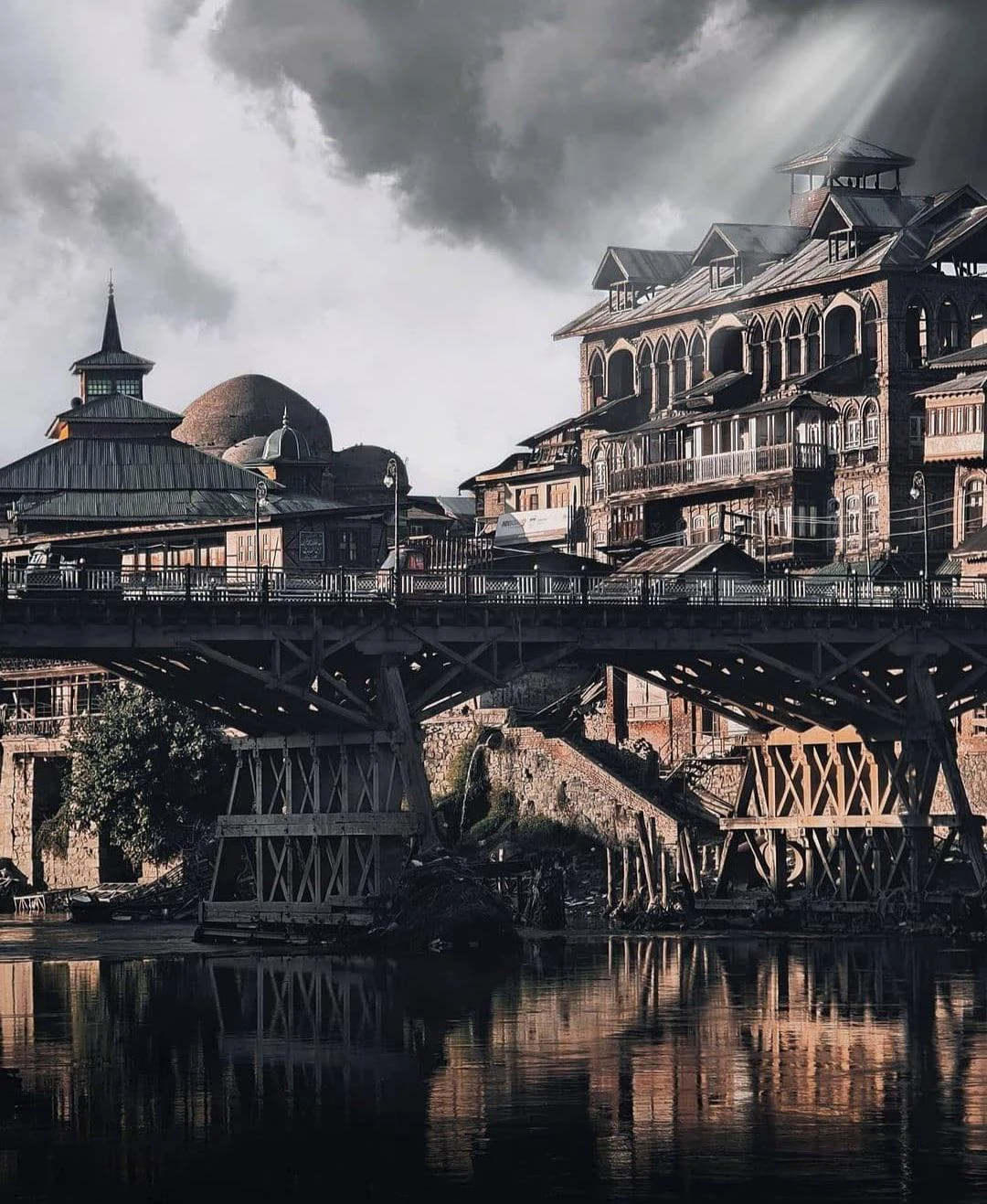
Most visitors see Srinagar from a shikara on Dal Lake or a houseboat balcony — and miss the city's actual heart entirely. Cross the Jhelum into downtown Srinagar, and you step into a different city altogether: narrower, older, and far more interesting. Locals simply call it “Downtown” — a tangle of wooden bridges, centuries-old shrines, and lanes that have barely changed their footprint since the Mughals passed through.
Crossing the Bridges
Downtown is stitched together by seven historic bridges, or kadals, each one a neighborhood in itself. Start at Zaina Kadal, named after the 15th-century Sultan Zain-ul-Abidin, and walk the riverbank rather than crossing straight away. The Jhelum here looks nothing like its postcard version near the lake — it's working water, lined with weathered wooden houses, their upper floors leaning slightly over the river as if listening in on it.
Architecture You Won't Find Elsewhere
Downtown's skyline belongs to two unmistakable structures:
- Jamia Masjid — Srinagar's grand mosque, built around a courtyard the size of a small park, held up by 370 wooden pillars, each reportedly cut from a single deodar tree. The scale of it is almost startling after the tight lanes leading up to it.
- Khanqah-e-Moula (Shah-e-Hamdan) — a riverside shrine wrapped almost entirely in carved wood and papier-mâché ceiling work, dedicated to the Persian saint credited with bringing many of Kashmir's signature crafts to the valley in the 14th century.
Both buildings reflect a distinctly Kashmiri style — pagoda-like tiered roofs, latticed windows, and wood construction adapted for heavy snow, found almost nowhere else in India.
The Craft Lanes
Downtown isn't just architecture — it's where much of Kashmir's handicraft economy still quietly operates. Wander the lanes around Zaina Kadal and Nowhatta and you'll pass workshops for copperware, papier-mâché, and walnut wood carving, often running out of the same buildings for generations. Unlike the curated handicraft emporiums elsewhere in the city, these are working spaces — expect noise, sawdust, and craftsmen who are usually happy to talk if you're not rushing them.
How to Actually Do It
Downtown rewards walking, not driving — the lanes are narrow, and a car will only frustrate you. Go in the morning, when the markets are setting up and the light hits the river well, and budget at least three unhurried hours. A local guide is worth it here; many of the smaller shrines and craft workshops have stories that don't make it onto any signage, and a familiar face opens doors that a stranger walking in alone simply won't get.
Why It's Worth the Detour
Srinagar's lake and gardens get the photographs, but downtown is where the city actually lives — five centuries of history compressed into a few square kilometers, still functioning as a neighborhood rather than a museum piece. Spend a morning here, and the rest of Srinagar starts to make a lot more sense.