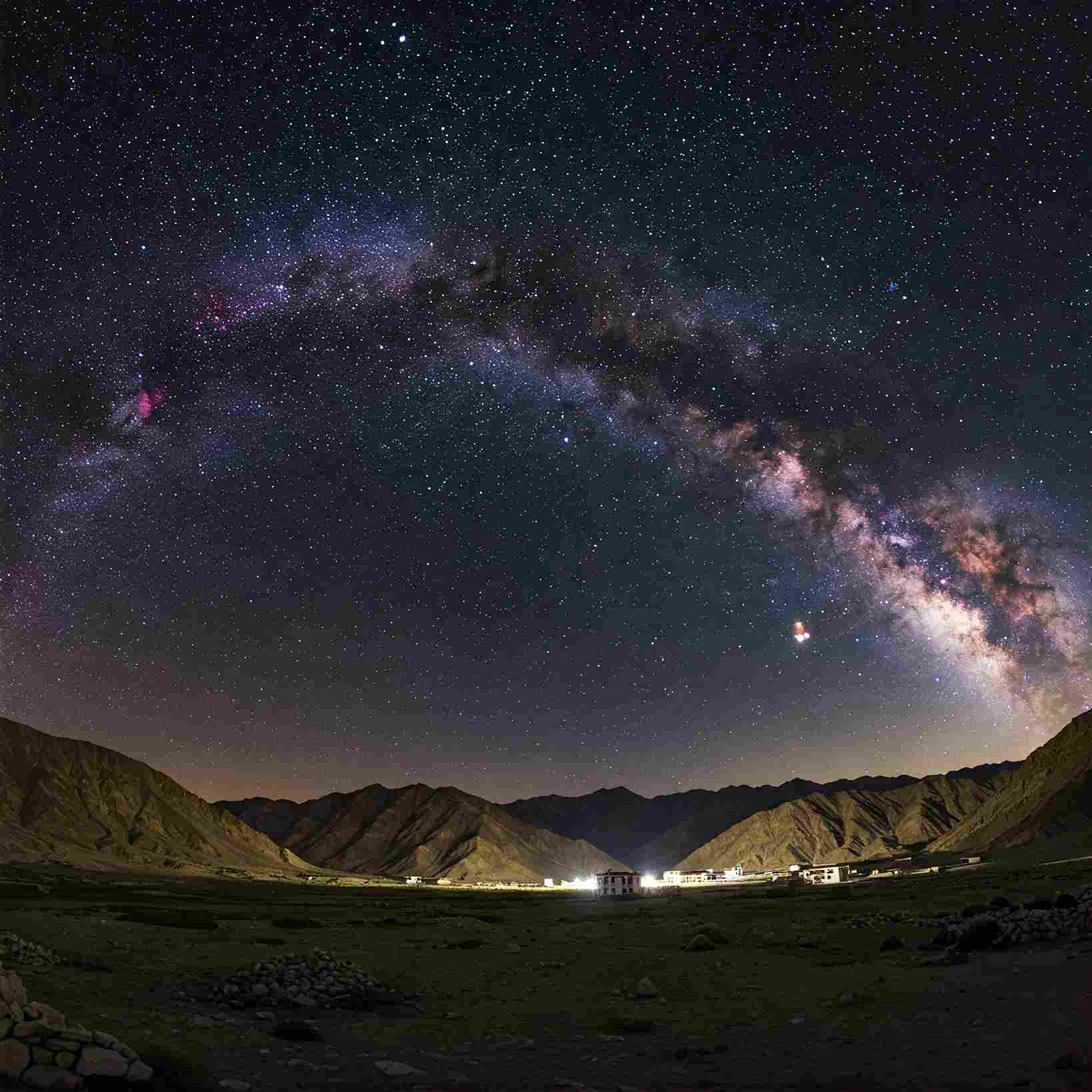
Somewhere past the last patch of cell signal, beyond Pangong and Nubra and every other name on a typical Ladakh itinerary, the road climbs into the Changthang plateau and arrives at Hanle — a windswept village at roughly 4,500 metres where the sky, quite literally, has nowhere else to compete for attention.
India's First Dark Sky Reserve
In late 2022, an area spanning over a thousand square kilometres around Hanle was officially notified as the Hanle Dark Sky Reserve — India's first. The reserve sits within the Changthang Wildlife Sanctuary and covers six villages, all brought under a light management plan that limits outdoor lighting, mandates shielded fixtures, and asks drivers to dim headlights near observation zones. The payoff: skies rated Bortle-1, the darkest classification on the scale astronomers use, found in only a handful of places on Earth.
Why Hanle, Specifically
The same conditions that make Hanle harsh for daily life make it extraordinary for astronomy — high altitude, bone-dry air, and roughly 270 cloud-free nights a year. It's no accident that the Indian Institute of Astrophysics chose this spot for the Indian Astronomical Observatory, one of the highest-altitude optical observatories in the world, along with the MACE gamma-ray telescope. On a clear, moonless night, the Milky Way doesn't just appear overhead — it stretches from one horizon to the other, dense enough to cast a faint glow on the ground.
Stargazing With the Locals
What makes Hanle unusual isn't only the sky — it's who's showing it to you. As part of the reserve's community program, two dozen local villagers have been trained as Astronomy Ambassadors, equipped with their own telescopes to guide visitors through the night sky. It's a rare astrotourism model: the same families who herd yaks and grow barley by day spend clear nights pointing out Saturn's rings and the Andromeda galaxy to travelers who've made the long journey out. The reserve also hosts an annual star party drawing amateur astronomers and astrophotographers from across India.
Before You Go
A few things worth knowing ahead of the trip:
- Acclimatize first. Hanle sits at extreme altitude, roughly 275 km from Leh. Spend at least 48 hours adjusting in Leh before heading out, and avoid combining it with other high-altitude stops too quickly.
- Best season: May to September for road access and reliably clear skies; aim for nights around the new moon for the darkest views.
- Stay local: Accommodation is mostly homestay-style — book ahead, and consider it part of the experience rather than a compromise.
- Light discipline matters. Avoid bright torches, camera flashes, or drones near the observation areas — the reserve's entire purpose depends on visitors respecting the dark.
- Permits and fees: Confirm current entry requirements, as Hanle lies close to a sensitive border region.
A Sky Worth the Distance
Hanle isn't a place you stumble into. It takes a deliberate detour, a long drive, and a willingness to sit in the cold for hours waiting for your eyes to adjust. What you get in return is a sky most people only see in photographs — and the rare, disorienting feeling of realizing just how much we normally miss.